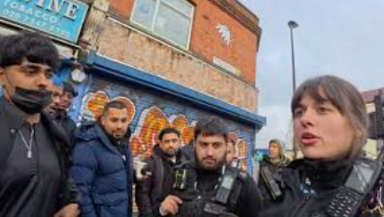
It is good news that a senior Metropolitan Police officer has praised the constable who defended a Christian street preacher’s freedom of speech in Whitechapel, east London. But pro-free speech campaigners would be naïve to think that the culture of the Met will change overnight.
Met Assistant Commissioner (AC) Matt Twist was speaking at the London Assembly’s police and crime committee on February 25 after a viral video showed the female officer calmly telling a crowd of angry men who objected to Christian preaching in a “Muslim area” that, “In this country, we have freedom of speech.”
According to the London Standard, Susan Hall, the leader of City Hall’s Conservative group, told AC Twist: “I particularly want to congratulate you on your female officer, who I think it was in Whitechapel, actually reminded people what the meaning of free speech is. I really would like to commend her and I would love to see more police officers actually doing that. I hope you thank her on behalf of very many of us.”
He replied: “Thank you for noting the great work of PC {Police Constable} Moule who was in Whitechapel. It’s been reposted a number of times on differing social media accounts, some more politicised than others. My view is it was a good example of officers showing policing common sense without fear or favour and doing a good job.”
But despite this commendation the unfortunate reality is that the Met’s track record on upholding freedom of speech has been poor.
Among the most egregious of cases was the arrest of Christian street preacher and pensioner, John Sherwood, in Uxbridge in April 2021.
He had been preaching on Genesis 1:27 near Uxbridge tube station and said that the family unit as ordained by God consisted of a father and a mother, not two fathers or two mothers. Some passers-by complained to the police that he was using homophobic hate speech.
The pastor, then 71, was arrested, held overnight at a police station and the following September was charged under Section 5 of the Public Order Act, which outlaws "threatening or abusive words or behaviour likely to cause harassment, alarm or distress".
Pastor Sherwood's successful defence centred on the freedom "to hold opinions and to receive and impart information and ideas without interference by public authority" as set out in Article 10 of the 1998 Human Rights Act.
The nature of his arrest, which was captured on video, was condemned as "brutal" by campaign group Christian Concern.
The Met had been quick to defend the officers who arrested Pastor Sherwood, issuing a statement at the time that said: “At 13:35hrs on Friday, 23 April, officers on patrol were flagged down by a member of the public who made them aware of a man allegedly making homophobic comments close to Uxbridge Underground Station. A number of other people also approached the officers with concerns about the man’s language.
“Officers spoke with the 71-year-old man and he was subsequently arrested on suspicion of an offence under Section 5 of the Public Order Act. He was taken to a west London police station and later released under investigation. A file has been passed to the Crown Prosecution Service [CPS] for review and consideration. The Met’s Directorate of Professional Standards [DPS] have since assessed the footage and found no indication of misconduct. The arrest will not be subject to a full DPS review.”
Sherwood was acquitted by Uxbridge Magistrates’ Court in 2022.
The fact that the Met officers who arrested Pastor Sherwood were so eager to clamp down on “homophobic comments” pointed to an anti-free speech culture in the Force. When an institution becomes captured by neo-Marxist ideology, it goes out of its way to prioritise groups with “protected characteristics” and prevent them from being offended by the exercise of free speech, particularly by Christians proclaiming Britain’s traditional faith and morality.
It remains to be seen whether PC Moule’s actions and AC Twist’s commendation will lead to culture change in the Met. But one suspects that there are still powerful anti-free speech forces in the higher echelons of the Force, committed to neo-Marxist ideology.
Before AC Twist made his comments at the London Assembly, Toby Young, General Secretary of the Free Speech Union, wrote in The Telegraph: “I don’t know the officer’s name – the Metropolitan Police have declined to comment – but she deserves a medal. What she demonstrated, under considerable pressure, was a good grasp of the law: that a person preaching peacefully in a public place is exercising a right protected by Article 10 of the Human Rights Act 1998, and that the feelings of bystanders, however loudly expressed, are irrelevant. Unfortunately, she is the exception rather than the rule.”
The pro-free speech resistance in Britain, especially among orthodox Christians, would be unwise to be complacent. Without radical culture change in the Met, the battle for Christian freedom of expression on the streets of London is far from over.
Julian Mann, a former Church of England vicar, is an evangelical journalist based in Lancashire.