Kuwait’s first church has been formally elevated to the status of a Minor Basilica, marking a significant milestone for the country’s Christian community and for churches across the Gulf region.
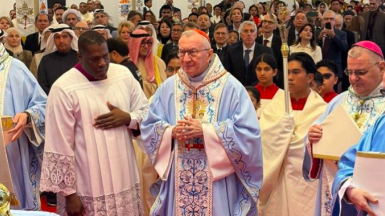
The designation was announced during a service held on Friday at the Our Lady of Arabia Church in Al-Ahmadi.
The ceremony was led by Cardinal Pietro Parolin, Secretary of State of the Holy See, who was visiting Kuwait for the occasion.
Minor Basilica status is granted by the Vatican to churches recognised for their historical and spiritual significance, architectural character, or pastoral role.
The elevation makes the Al-Ahmadi church the first in Kuwait - and one of the very few in the Arabian Peninsula - to receive the title, reports Vatican Media.
During the service, Cardinal Parolin also reflected on the Gospel reading appointed for the day, whereby Jesus enquires of His disciples, “Who do people say that the Son of Man is?”
Looking back on the Christmas period, he stated that welcoming Jesus requires more than celebrating his birth, stressing that believers must recognise who Christ truly is and what that identity means.
Cardinal Parolin described the moment marking the new status as historically significant not only for Christians in Kuwait, but for the wider Arabian region, noting the rarity of such recognition in the Gulf.
The congregation included members of Kuwait’s Christian community alongside diplomats, government figures, and officials from Kuwaiti Oil Company, reflecting the church’s longstanding presence within the country’s social landscape.
The church’s origins date back to 1948, when a small group of foreign workers, many employed in Kuwait’s emerging oil industry, established a modest chapel to serve the growing Christian population.
Located in Al-Ahmadi, near major oil facilities, the chapel reflected the rapid demographic changes taking place as expatriate workers arrived from across Asia and the Middle East.
As the workforce expanded, the chapel was replaced by a permanent church building, which became a central place of worship for Catholic migrants living and working in the country.
Over the decades, the church has remained closely tied to Kuwait’s oil industry and to the presence of migrant labour that continues to shape the nation’s economy.
According to Operation World, Christians are estimated to make up around 13.8% of Kuwait’s population.
The vast majority of Christians in Kuwait are expatriates. The Catholic Church of Kuwait estimates that the total Christian population is about 200,000, alongside a small indigenous community of roughly 200 Kuwaiti citizens.
Catholics number around 75,000, largely made up of migrant workers from South and Southeast Asia and the Middle East.
Other Christian traditions are also well established, including evangelical (15,000 members), Coptic Orthodox (over 60,000 members), and Anglicans (115), as well as various smaller traditions, together serving tens of thousands of worshippers across the country.
While religious freedom in Kuwait operates within clear legal boundaries, the country is regarded as one of the more accommodating Gulf states for Christian worship.