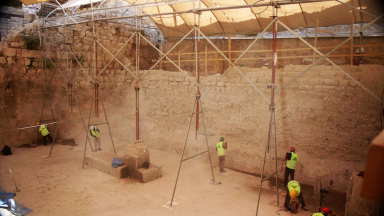
Archaeologists in Israel have uncovered a huge wall in Jerusalem that served as a foundational architectural feature in the biblical Pool of Siloam.
In the Gospel of John, chapter 9, Jesus instructs a man who was born blind to go and wash in the Pool of Siloam. The man does so and gains his sight.
The miracle was particularly significant as it became a notable flashpoint in Jesus’ relationship with the Pharisees, who launched an intensive investigation into the healing. That investigation led to the famous quote, used in the hymn Amazing Grace, “whereas I was blind, now I see”.
The pool, which is now located in the City of David National Park, was effectively the result of the building of the oldest dam in Israel. Experts have speculated that the dam may have been built to deal with a climate crisis 2,800 years ago.
One of the excavation directors on the site, Itamar Berko, said, “This is the largest dam ever discovered in Israel and the earliest one ever found in Jerusalem.
"Its dimensions are remarkable: about 12 meters high, over 8 meters wide, and the uncovered length reaches 21 meters – continuing beyond the limits of the current excavation."
He continued, "The dam was designed to collect waters from the Gihon Spring as well as floodwaters flowing down the main valley of ancient Jerusalem (the historical Tyropoeon Valley) to the Kidron Stream, providing a dual solution for both water shortages and flash floods.”
According to Berko, the dating of the wall as a late 9th century BC construct is unusually precise. Twigs and branches embedded in the construction mortar provided helpful clues. Other data about the climate of the time was used to give a more precise date for the wall’s construction.
The newly discovered wall connects an ancient water network that began with a large tower damming the Gihon Spring, moving on to a channel that led to the Pool of Siloam, which was supplemented by floodwaters blocked by the newly discovered dam.
Eli Escusido, Director of the Israel Antiquities Authority, said, “This is one of the most impressive and significant First Temple-period remains in Jerusalem, and has been preserved to an extraordinary degree. The revealed dam is awe-inspiring and opens new avenues of research.
“The discovery of the dam and the Siloam Pool in the City of David is the result of perseverance, professionalism, and archaeological determination.
"In recent years, Jerusalem has been revealed more than ever before, with all its periods, layers, and cultures – and many surprises still await us.”